
Issue No.9

By Asit Shah, founder, Zazzy Box
It's 11 p.m., and one of our customers texts me about a custom engagement ring. He's sent a list of questions and 15 reference images he found online. He wants to know if I can pull elements from each into one design.
A few years ago, that message would have sat in my personal phone until morning while also probably sitting in the back of my mind overnight. I'd have woken up, scrambled, called the customer, looped in a designer, and walked through what he'd sent.
My company Zazzy Box creates custom diamond jewelry, and our customers expect to be able to text the person making their ring. They send photos at all hours, questions on weekends, sometimes a sketch their friend drew on a napkin. If we don’t respond quickly and thoroughly, we lose them as a customer.
Honestly, at first I hated how much of my business ran on text. I was the bottleneck, and I knew it. Every order and every conversation came to my personal phone.
I couldn't keep handling every customer conversation. Something had to change. Here are a few key things that bought my team back roughly 160 hours a month.
Looping in the entire team
Two years ago, I gave my designers and overseas staff direct access to customer conversations. My industry is old school and afraid of transparency. If anyone heard I'd done it, they'd think I was a fool and a bad businessman. I did it anyway.
Now, by the time I open a thread the next morning, a designer in another time zone has already read the message, pulled the references into our system, and started the work. There's a note: "I went ahead and got this started. Let me know what you want to change." I can see when they're on a conversation and I'm thinking, "Man, my designers are doing their homework." Internal threads handle clarifications without anyone playing telephone (pun intended) between the customer and the person making their ring.
Getting faster solved one problem and created another: more hands on the same accounts, less context about who was who. You wouldn't believe how many Adams, Johns, Muhammads, and Elises end up in our system. For a while, we'd send the wrong design to the wrong customer more often than I want to admit.
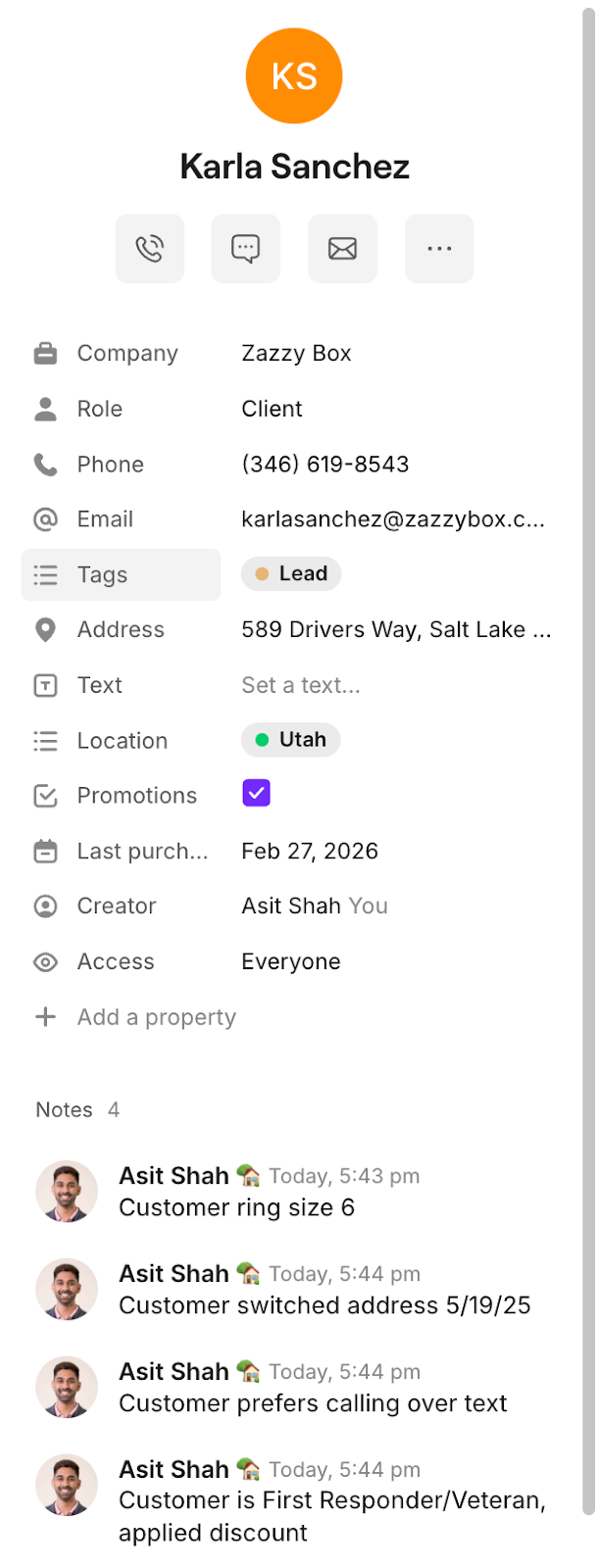
So we store everything directly in Quo, instead of stacking another CRM on top. Each contact has multi-select tags — customer, prospect, VIP. The notes field catches the details a teammate might need to make a customer feel understood, like their communication preferences and order history.
If you're already using Quo, custom properties and contact notes are straightforward to set up. Here are a few other ways you can use custom properties.
Last year, I ran an undercover shopping study on around 40 jewelers. This didn’t require a wig or fake mustache. I sent the same custom quote request to all of them on a Monday. About a third came back the same day with real quotes. Another third responded within 48 hours, but mostly with “we'll get back to you”. The rest took up to a week.
Our turnaround time at Zazzy Box is 24 hours. Our rings ship in two to three weeks, against an industry average of six to eight. Most of those 160 hours we save in a month come from work that used to live in handoffs that lived outside of our Quo workspace, but that now happens in a single thread.
Use AI on call transcripts, without an agency
Scope creep is the worst. It eats margins for any business. For us, that can mean we start with one design. Then a customer wants edits, then they ask for three more designs to choose from. The work compounds, but the price doesn't.
As a small business, I couldn't afford an agency to listen to our customer conversations, find patterns, and write training materials. I also wasn't comfortable handing over customer data.
So I connected Quo's call transcripts to Claude. I run sentiment and tone analysis across them, then ask it to write scripts for the most difficult recurring situations. For us, that includes telling a customer they've exceeded their revision allowance, while making them feel like we're making an exception.
Connecting Quo to Claude only takes a few minutes. Three prompts in particular have done the most work for our team:
- A scope-creep script: Look up all our call transcripts with customers for the past quarter. Based on these transcripts, write 5 response snippets our team can copy and paste when a customer asks for additional design revisions beyond what's included. The tone should be friendly, firm, and make the customer feel like we're making an exception — while clearly communicating our standard process.
- A tone comparison for new vs. repeat customers: Compare the tone and sentiment of our conversations with first-time customers vs. repeat customers. Are there noticeable differences in how we communicate with each group? Where are we strongest, and where do we lose people?
- A competitor pricing objection: Based on these transcripts, write a script for when a customer compares our pricing to a cheaper competitor. The response should acknowledge the comparison without being defensive, highlight what's different about our process, and redirect to value rather than price.
The output goes into Notion docs, snippets, and short Loom videos my team uses to coach designers — including overseas staff who don't write business English natively — and to onboard new hires faster than I could manage on my own. As a small business, it's expensive to have a team analyze conversations and come up with suggestions to train suppliers. This has been a game-changer.
Early on, we stress-tested AI tools like Claude and ChatGPT. The turning point came when an intern copy-pasted AI-generated scripts directly to customers. One customer thought it was a bot and gave us negative feedback. Their reaction made one thing clear: people still want to know there's a human on the other end. That lesson shaped how we use Claude and other tools with Quo today. The value isn't automation for its own sake — it's context. AI can draft the explanation, but customers want a clear sign that someone real is behind the screen, paying attention.
Three things to try this week
These small tweaks helped us the most, and none of them took longer than a lunch break to set up.
1. Add behavioral notes to your top 20 contacts. Open each one in Quo and drop in one sentence about how they like to communicate and what they care about. Next time anyone on your team picks up the thread, they'll have context.
2. Give one more person shared inbox access. If there's a handoff in your workflow — intake to fulfillment, sales to service, you to a contractor — put them on the same thread this week instead of relaying information. You may be surprised at how much better things work without you needing to intervene.
3. Pull your last five difficult customer conversations and run them through Claude. Ask: “What was the customer really asking for? Did we address it? Write a snippet for the next time this comes up.” The transcripts are already in Quo, so it requires zero setup.
On June 17, I'm walking through the Zapier workflows that also help my team save 160 hours every month. If you've been the one answering texts at 11 p.m., come join us. RSVP here.
_01KCHSK3REEYGGXZDYD0MV3VWW.png)
Quo
2261 Market St PMB 4157
San Francisco, CA 94114-1612


This email was sent to trongrau1368.taphone@blogger.com. Update your email preferences
Đăng nhận xét